In today’s open-plan offices, noise has become one of the biggest challenges managers and teams face daily. Conversations between colleagues at adjacent desks, ringing phones, the hum of printers, footsteps in the hallway, and even the distant sound of an elevator create a constant, irritating background sound that distracts, strains the ears, and reduces the overall effectiveness of the entire team. The PN-N-01307 standard precisely defines acceptable equivalent noise levels: in large open spaces (over 10 workstations), noise levels should not exceed 55 decibels during a standard 8-hour workday; in medium-sized rooms (4-10 people) – 50 decibels; and in small, individual offices – just 35-40 decibels. These limits are not a fabrication – they stem from years of research on the impact of noise on mental and physical health, protecting against chronic acoustic fatigue, increased stress, decreased concentration, and even an increased risk of professional errors.
Why is noise in open-plan offices such a significant problem for companies? Imagine a software developer trying to debug code or a graphic designer designing a layout – constantly interrupted by snippets of conversation, laughter, or phone notifications. University publications indicate that in such conditions, employees lose as much as 20-30% of their productive time “fighting the noise”: they repeat tasks, lose track, and find it harder to focus on data analysis, writing reports, or even simple emails. The PN-EN ISO 3382 standard supplements these requirements with key measurements such as reverberation time (the time it takes sound to bounce off the walls, ceiling, and floor). In an optimal office, this indicator should be short – less than 0.6 seconds at mid-speech frequencies (500-1000 Hz), where we most often communicate daily. This allows words to sound clearer, conversations to be less tiring, and speech intelligibility to increase, which is especially important in an era of daily videoconferencing, Zoom, and distributed teamwork.
This is where acoustic panels come in – modular, easy-to-install solutions that effectively absorb sound, preventing uncontrolled reflections throughout the room. Consider a typical 200-square-meter open-plan space: without any absorption, noise easily reaches 60-65 decibels, reminiscent of the constant hum of a car fan or a crowded coffee shop right next to your ear. After strategically installing absorbent panels on the walls, ceiling, and windows – covering approximately 25-30% of the total area – noise levels drop by 5-10 decibels within a few days. This isn’t dry theory, but rather a measurable improvement: speech becomes crystal clear, background noise ceases to be an irritating “noise,” and employees end the day feeling less exhausted. For example, in areas with the highest conversation volume (e.g., at central desks), panels are installed on the “first reflection” walls – those where sound strikes directly from the speaker’s mouth, blocking the chain of reflections.
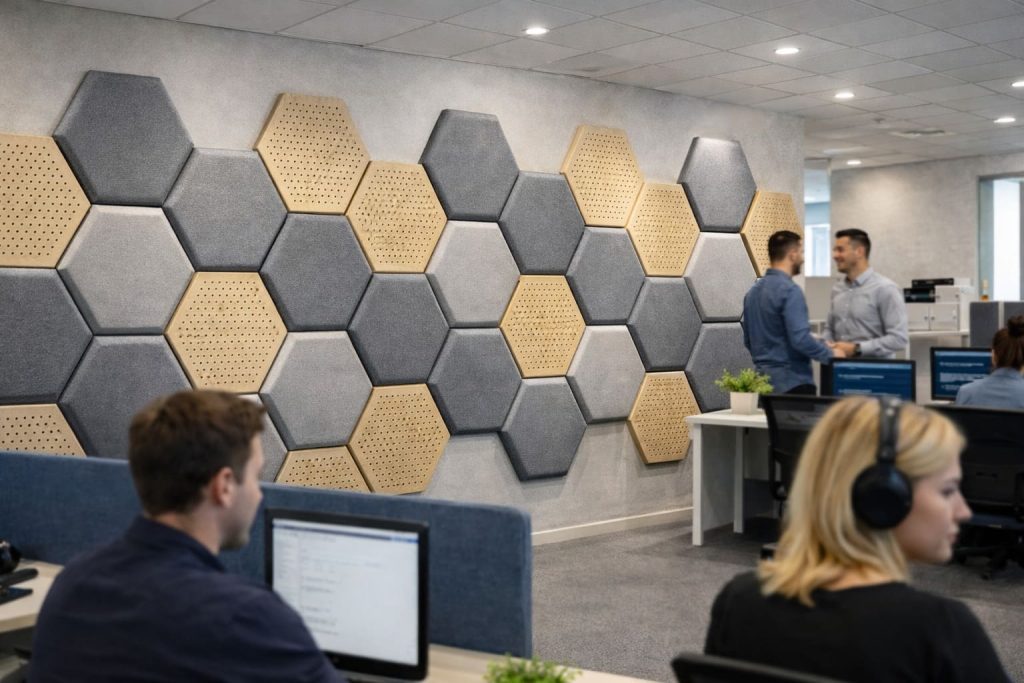
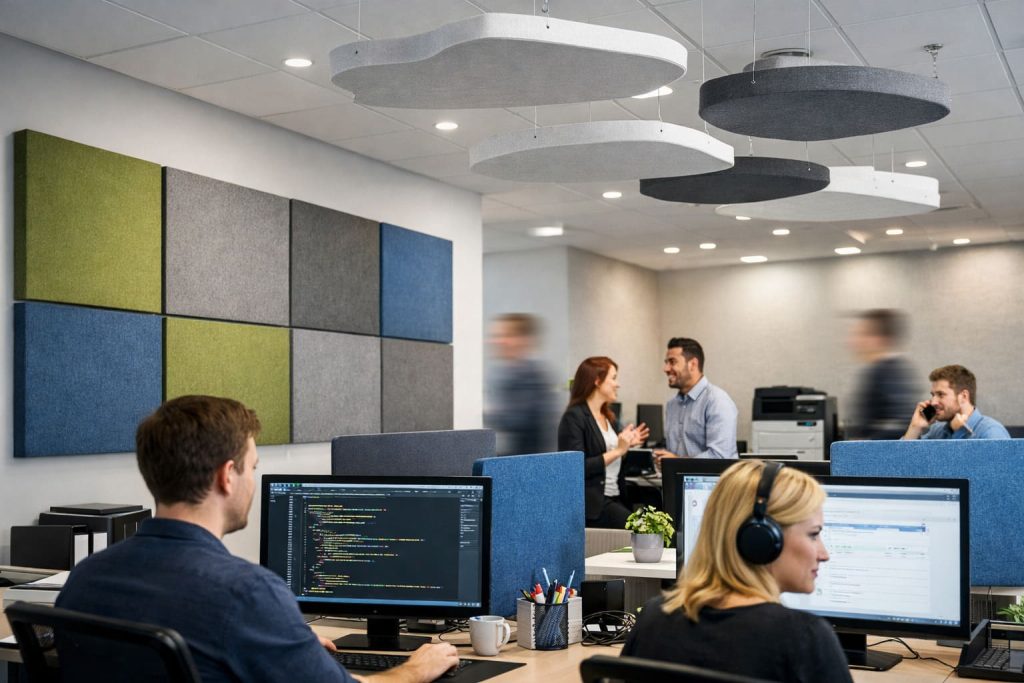
Installing the panels is incredibly simple and doesn’t disrupt daily office operations – no renovation crews, drills, or wall painting required. They can be attached with specialized mounting tape, hung on hooks, or attached directly to existing surfaces with Velcro. The most effective locations include: walls opposite desks (1-1.8 meters high, 2-4 meters wide), ceiling-mounted “acoustic clouds” hanging 2-3 meters above conference tables, corner low-frequency absorbers (bass echoes from footsteps and closing doors), and panels on hallway partitions. This way, the office not only meets stringent acoustic standards without costly renovations, but also provides a space that supports both individual work (e.g., writing code) and group work (brainstorming, presentations).
The practical benefits of implementing panels are immediate and tangible: teams complete tasks faster, make fewer errors due to distraction, take their hearing aids less often for migraines or acoustic stress, and internal satisfaction surveys increase by 15-25%. New employees are more likely to apply to companies with modern, quieter offices – this becomes a strong element of employer branding. Companies installing panels report improved internal communication: fewer misunderstandings in briefs, clearer feedback, and more effective team meetings. In the long run, it’s a smart investment that pays off in higher productivity, lower turnover costs, and improved financial results. Acoustic panels are evolving from a gadget to a standard in 21st-century office equipment, where every detail – from team health to innovation – determines competitive success.
Sources:
https://medpr.imp.lodz.pl/pdf-100632-40369?filename=Computational-studies-of-.pdf
https://ptakrakow.pl/PTAkrakow_materialy/OSA2021_postepy_akustyki_2021_v2.pdf
https://ogpta.pl/images/SZASIW_poprzednie_konf/materialy2017.pdf