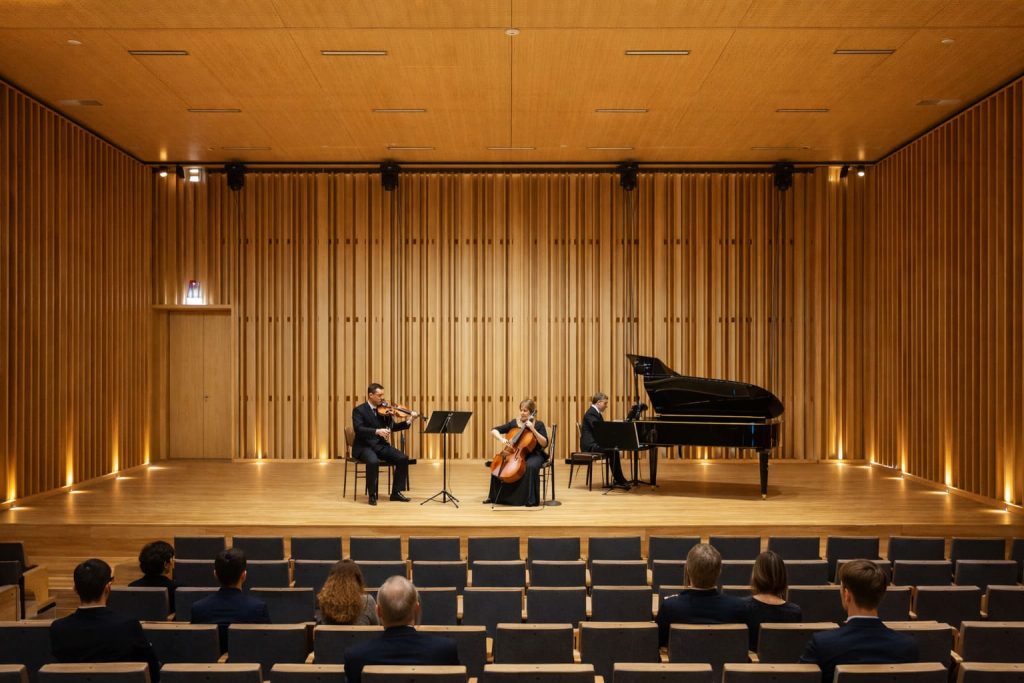
Concert halls, auditoriums, theaters, and lecture halls require precise acoustics, where every sound must be clear, balanced, and reach the audience evenly. In such spaces, air conditioning noise, wall echoes, and uneven music dispersion can be disruptive – audiences hear distortion, artists lose feedback, and organizers risk negative reviews. The PN-EN ISO 3382-1 standard defines parameters such as early reflections (C80 > -2 dB), reverberation time RT60 (adjusted to the hall size, e.g., 1.8-2.2 s for a 1000-seat philharmonic hall), and speech clarity Ts (≥50 ms), ensuring that sound is “alive” yet controlled.
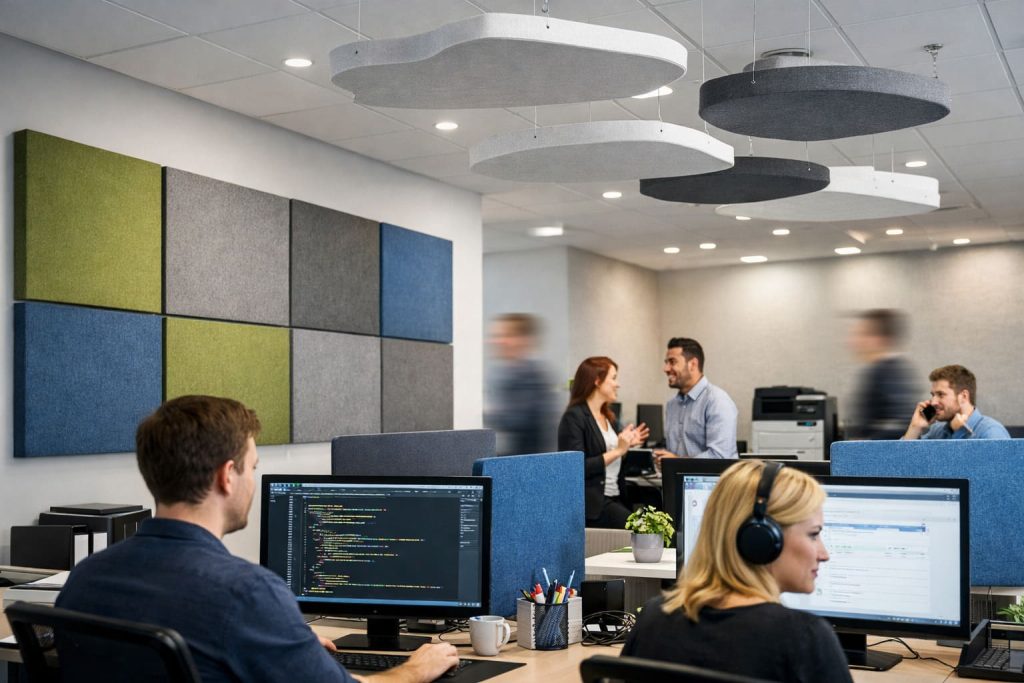
Achieving acoustic uniformity without costly renovations is a challenge in large auditoriums (500-2000 m²). Specialized acoustic panels with adjustable absorption (e.g., fabrics on sliding rails) allow for dynamically changing the RT60 by 20-30% – during a classical concert, they lengthen the reverberation for warmth, while during a lecture, they shorten it for clarity. Consider a university auditorium: without absorption, sound “escapes” into dead zones, and the audience in the back hears less. Installing 50-100 wall panels (αw 0.7-0.9) and 20 ceiling diffusers evenly disperses the waves, improving the STI to 0.65+ and eliminating noise hotspots.
In concert halls, installations using rear wall modules prevent the “banana effect” (uneven amplification), while perforated panels above the stage control vocal feedback. For theaters, fabric-adjustable panels allow switching between drama (longer reverberation) and musical (shorter). For example, in an 800-seat auditorium, 30% of the surface covered with panels reduces unevenness by 8-12 dB, as confirmed by ray-tracing simulations.
Benefits for owners: the multifunctional nature of the space (concerts, conferences, events) increases occupancy by 40%, attracting artists and speakers. Audiences praise the “excellent acoustics,” which builds the reputation of the auditoriums – they experience higher attendance and ticket revenue. For universities, auditoriums become flagship venues, supporting prestigious lectures and podcast recordings.
In practice, implementation begins with field measurements (binaural microphones, implosion balloon), then computer simulation and modular assembly – without compromising the facility. Specialized panels combine acoustics with design, integrating with LED lighting and projections. It’s an investment in the future: concert halls with adaptive acoustics are dominating the event market, offering a premium experience in the era of streaming and hybrid performances.
Sources:
https://sound.eti.pg.gda.pl/student/tnagl/Metody_pom_char_wnetrz
https://ptakrakow.pl/PTAkrakow_materialy/OSA2021_postepy_akustyki_2021_v2.pdf
https://ogpta.pl/images/SZASIW_poprzednie_konf/materialy2017.pdf